
Iran has complained of irregular shipments

Barring rice, spices, iron ore and pharmaceuticals, all the remaining 26 key sectors registered negative growth in May. Imports too plunged 51 per cent to $22.2 billion in May.

The textiles sector was most affected witnessing a massive drop in contractual employment as outward shipments shrank

After recording positive growth in September, India's exports declined 5.4 per cent to $24.82 billion in October on account of dip in shipments of petroleum products, gems and jewellery, leather, and engineering goods. Trade deficit in October narrowed to $8.78 billion as against $11.76 billion, as imports also fell 11.56 per cent to $33.6 billion during the month under review.

Under the trade agreement between India and Iran, the West Asian country can pay India in rupees for its imports against oil exports to India, which New Delhi pays for in Iranian rial.
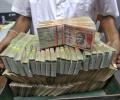
India's merchandise exports shrank nearly a quarter in September from a year ago, government data showed.

Imports too dipped by 23.1 per cent to $25.41 billion in the month under review as against $33 billion in April 2015.

Trade deficit marginally widened to $9.85 billion as against $9.72 billion in February 2019.

Nepal's decision to ban the import of non-essential items amid depleting forex reserves may hit Indian exports. The country's central bank - Nepal Rastra Bank - last week instructed commercial banks not to open letters of credit (LCs) for importing non-essential items. This is to prevent further decline of the country's foreign exchange reserves. However, it has not issued any formal communication yet.
The country's exports rose by 47.34 per cent to $32.46 billion in June on account of healthy growth in sectors such as engineering, gems and jewellery and petroleum products, even as trade deficit aggregated at $9.4 billion during the month, according to the data released by the commerce ministry on Friday. Exports in June last year stood at $22 billion and $25 billion in June 2019. In May 2021, the outward shipment was worth $32.27 billion, while in April this year, it was $31 billion. Imports in June 2021 grew by 96.33 per cent to $41.86 billion, from $21.32 billion in June last year. In June 2019, imports stood at $41 billion.

While the import of gold fell by about 11 per cent to $2.58 billion in February as against $2.89 billion in the corresponding month last fiscal, inward shipments of petroleum products were down by nearly 8 per cent to $9.37 billion.

Imports too declined 26 per cent to $29.47 billion in August, leaving a trade deficit of $6.77 billion.
Imports too tumbled by 58.65 per cent to $17.12 billion in April from $41.4 billion in the same month last year, according to the data by the commerce and industry ministry.
Imports rose by 1.44 per cent to $43.44 billion in March 2019.

The United States has lifted most of its sanctions against Iran after a UN watchdog reported that Tehran had complied with a nuclear weapons deal.
The country's exports grew by 47.19 per cent to $35.17 billion on account of healthy growth in the outbound shipments of petroleum, engineering, and gems and jewellery, according to the provisional data of the commerce ministry. Imports during the month also rose by 59.38 per cent to $46.40 billion, leaving a trade deficit of $11.23 billion. Exports of petroleum, engineering, and gems and jewellery in July increased to $3.82 billion, $2.82 billion and $1.95 billion respectively, the data showed.

Russia is among the top buyers of Indian tea, accounting for about 18 per cent of the industry's total exports.
The deficit would have been lower if gold imports hadn't shot up 85.16 per cent last month to $2.91 billion

India's exports dipped deeper in the negative zone.
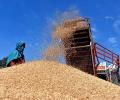
The uptick in prices ranging from steel to wheat could benefit lots of commodity-based companies -- from State-owned SAIL to the agro exporters.

Growing for the third consecutive month, the country's exports rose marginally by 0.67 per cent year-on-year to $27.93 billion in February even as trade deficit widened to $12.62 billion, according to official data released on Monday.

India's merchandise exports in February shrank for the 15th straight month on continued weak demand from Europe, the South Asian nation's biggest market.
Export sectors that showed positive growth last month included chemical, iron ore, electronics, marine products and pharmaceuticals. Decline in overall imports, including oil and gold, led to narrowing of trade deficit.
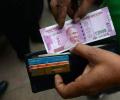
According to SBI Ecowrap, every $10/barrel increase in oil price results in additional import bill of $8 billion.

So far, Andhra Pradesh, Kerala, Telangana, Uttar Pradesh and West Bengal governments have taken the imported onions.
Imports during October also rose by 17.62 per cent to $44.11 billion, leading to widening of trade deficit to $17.13 billion.

The US hopes India will "reconsider" its decision to ban wheat exports, with Washington "encouraging" countries not to restrict exports as that will exacerbate food shortages, amidst Russia's invasion of Ukraine. India, the world's second-biggest wheat producer, has banned wheat exports in a bid to check high domestic prices amid concerns of wheat output being hit by scorching heat waves. The decision would help control retail prices of wheat and wheat flour, which have risen by an average 14-20 per cent in the last one year, besides meeting the foodgrain requirement of neighbouring and vulnerable countries.
The trade gap - difference between imports and exports - was $11.39 billion in March 2015.

Imports of milk, foodgrains, edible oils and pulses, considered sensitive for domestic producers, surged by 40.5 per cent in 2009-10 to Rs 65,564 crore (Rs 655.64 billion).

The deficit was $17.6 billion in April 2013.

The 30-share Sensex ended down 110 points at 25,474 after hitting a record high of 25,736 and the 50-share Nifty ended down 30 points at 7,627 after touching a record high of 7,700.

Edible oil, milk and milk products fall in the sensitive items category and their imports are monitored by the government to ensure that they are not causing any adverse impact on domestic firms, particularly small and medium.

India is the largest importer of gold after China.

Imports also rose by 2.6 per cent to $41.1 billion in the month under review, leaving a trade deficit of $14.92 billion.
Export growth picked up mainly owing to rising global crude prices, which pushed up processed petroleum exports by nearly 40 per cent, apart from a broad-based improvement in exports of major foreign exchange earners such as engineering goods and gems and jewellery.

According to data released by the commerce and industry ministry, exports stood at $25.01 billion in the month. The fall is only the second time exports contracted in the past year.

Chidambaram said he expected gold imports to touch $40 billion in the current fiscal year to end-March, down 31 percent from the year-ago bill of $58 billion.

India's exports dipped after a gap of four months in March but finished 2017-18 with a healthy rise of 9.78 per cent to $302.84 billion.

Cumulative exports during April-August of 2017-18 rose by 8.57 per cent to $118.57 billion

Exports of petroleum products, chemicals, pharmaceuticals, gems and jewellery, and engineering goods registered a positive growth.
